The Horizon of General Intelligence: A 2026 Progress Update on AGI Development

Introduction: Redefining the AGI Roadmap in 2026
As we navigate through 2026, the discourse surrounding Artificial General Intelligence (AGI) has shifted from speculative ‘if’ to a logistical ‘when.’ The past twelve months have marked a significant departure from the era of Large Language Models (LLMs) toward more sophisticated, agentic, and multi-modal architectures. AGI, defined as the point where an AI system can match or exceed human cognitive performance across a broad range of economically valuable tasks, is no longer a distant sci-fi trope but a benchmark being approached with unprecedented engineering precision. This update explores the technical breakthroughs, infrastructure surges, and the emerging safety frameworks that define the current state of AGI development.
The Architectural Shift: From Prediction to Reasoning






The defining characteristic of AI progress in 2026 is the maturation of ‘System 2’ thinking in neural networks. While early models relied on fast, probabilistic word prediction, current architectures incorporate latent reasoning cycles—often referred to as ‘inference-time compute.’ This allows models to deliberate, self-correct, and explore multiple hypotheses before providing an output.
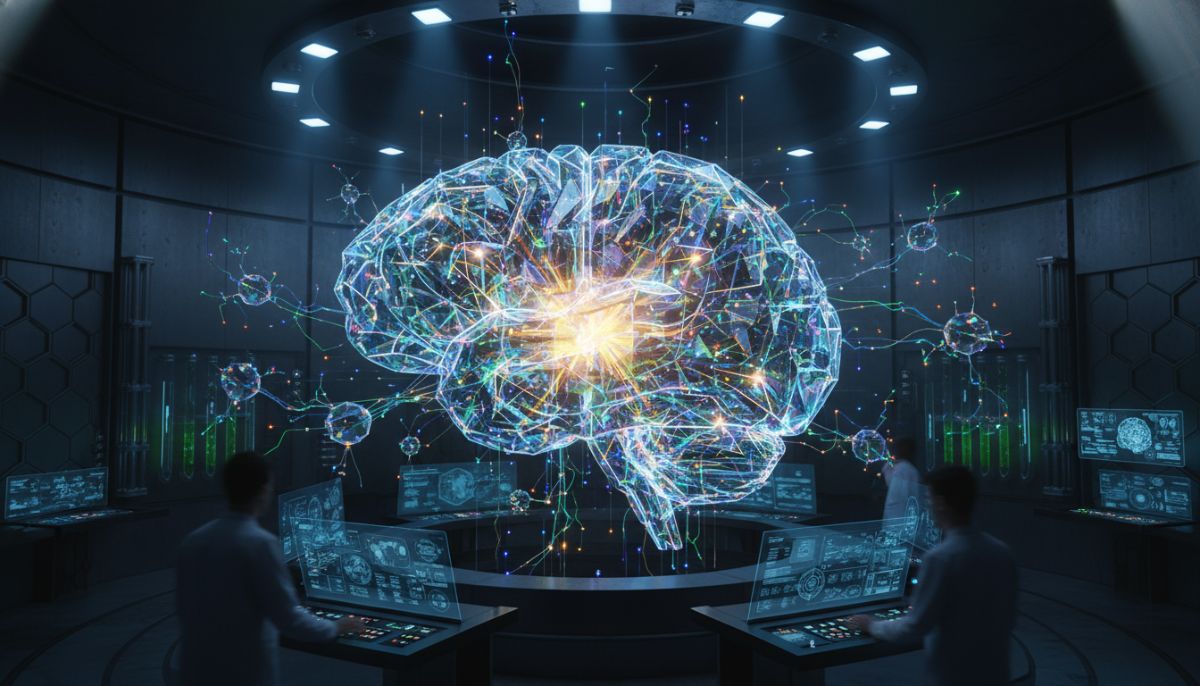
We have seen the widespread adoption of ‘World Models,’ which allow AI to maintain a persistent internal simulation of physical and logical reality. This enables the system to understand causality rather than just correlation. By integrating hierarchical planning capabilities, 2026-era systems can break down complex, multi-step goals into actionable sub-tasks, a prerequisite for true general intelligence.
The Infrastructure Surge: Energy and Compute at Scale
The path to AGI in 2026 is paved with silicon and power. The industry has moved beyond the GPU clusters of the early 2020s to massive, purpose-built AI data centers that consume gigawatts of power. The emergence of the ‘100-billion-dollar cluster’ has become a reality, with tech giants and sovereign nations investing in infrastructure that can support the training of models with parameters in the tens of trillions.
Furthermore, the ‘Data Wall’—the exhaustion of high-quality human-generated text—has been overcome through the sophisticated use of synthetic data pipelines and reinforcement learning from human feedback (RLHF) evolved into RLAIF (Reinforcement Learning from AI Feedback). These models are now learning from the universe of video, sensor data, and physical interactions, allowing them to gain a ‘grounded’ understanding of the world that text alone could never provide.
Quantifying Progress: The AGI Benchmark Evolution
In 2026, the industry has largely converged on a five-level classification system for AGI progress, similar to those proposed by leading research labs. We are currently witnessing a decisive transition from Level 2 (Reasoners) to Level 3 (Agents).
Level 3: The Era of Autonomous Agents
Today’s systems are no longer just chatbots; they are autonomous agents capable of managing complex workflows. They can conduct independent research, write and debug software across entire repositories, and even orchestrate other AI models to achieve a goal. The emergence of ‘Agency’ is the most significant milestone of 2026, as AI begins to demonstrate the ability to act on behalf of users in digital and, increasingly, physical environments via robotics.

The Physicality of AGI: Robotics and Embodiment
One of the most profound updates in 2026 is the narrowing gap between digital intelligence and physical embodiment. The same foundational models driving cognitive tasks are now being used as the ‘brains’ for general-purpose humanoid robots. These robots are no longer programmed with specific movements; instead, they learn via imitation and self-play, guided by the massive world models developed in data centers. This ‘Physical AGI’ allows for the automation of non-repetitive labor, from elderly care to complex laboratory experiments, marking a significant leap toward human-level versatility.
Safety, Alignment, and Mechanistic Interpretability
As models grow more powerful, the focus on AI safety has transitioned from theoretical ethics to ‘Mechanistic Interpretability’—the science of reverse-engineering neural networks to understand why they make certain decisions. In 2026, regulatory bodies have begun mandating ‘Safety Audits’ for any model approaching AGI-level capabilities.
The challenge of ‘Alignment’—ensuring that an autonomous agent’s goals remain consistent with human intent—remains the primary bottleneck. Researchers are now deploying specialized ‘Monitor AIs’ designed to oversee and verify the behavior of more complex systems, creating a recursive layer of safety protocols.

The Geopolitical and Economic Landscape
The race to AGI has sparked a new era of ‘Techno-Nationalism.’ In 2026, access to high-end compute is treated as a strategic national asset, similar to oil or grain reserves. Economies are beginning to feel the ‘AGI tailwind,’ with productivity gains in software engineering, drug discovery, and materials science accelerating at an exponential rate. However, this has also led to intense debates regarding the displacement of cognitive labor and the need for new economic models, such as Universal Basic Income or sovereign wealth distributions.
Conclusion: The Road to 2030
As 2026 draws to a close, the consensus among experts is that we are in the ‘final mile’ of the AGI journey. While we have not yet reached a system that can outthink the collective human species across every possible domain, the foundations are firmly in place. The transition from static models to dynamic, reasoning agents has fundamentally altered our relationship with technology. The next few years will likely focus on refining these agents, ensuring their safety, and integrating them into the very fabric of global civilization. The dream of AGI is no longer a matter of imagination, but a matter of refinement and responsible scaling.